
Type 1 Diabetes
Type 1 diabetes is an autoimmune condition where the body’s own immune system is activated to destroy the beta cells in the pancreas which produce insulin.
Type 1 diabetes is an autoimmune condition where the body’s own immune system is activated to destroy the beta cells in the pancreas which produce insulin.

The pancreas, a large gland behind the stomach, stops making insulin (a hormone) because the beta cells that make the insulin have been destroyed by the body’s own immune system. People living with type 1 diabetes depend on insulin daily to replace the insulin the body cannot produce. Without insulin, your blood glucose levels would increase rapidly, and you could become very ill. To monitor your insulin intake and overall wellbeing, you also must check your blood glucose levels throughout the day to ensure they stay within their target range and keep you safe and well. This can be done using a blood glucose monitor or continuous glucose monitoring system (CGM).
Join Our Type 1 Diabetes Community Network Programme and get support on your diabetes journey. If your child is diagnosed with diabetes – join our Family Programme!
Check out the special section about Diabetes in children and youth here

We do not know what causes type 1 diabetes and the autoimmune reaction which destroys your beta cells. What we know is that some environmental factors are thought to set off the process – we call them triggers, for example an infection or high levels of stress.
We also know that people living with type 1 diabetes may have one or several genes responsible for the development of type 1 diabetes. For now, it cannot be prevented and there is no cure, but research to find the cure and prevention of the process is ongoing.
Without insulin, glucose builds up in the body causing high blood glucose levels (hyperglycaemia). The kidneys attempt to wash the excess glucose out through the urine, resulting in dehydration. The body burns its own fat reserves to supply energy which releases chemical substances in the blood called ketone bodies.
Without ongoing injections of insulin, these ketone bodies accumulate. The high glucose and ketone levels along with dehydration can be life threatening if it is not treated. This is a condition called diabetic ketoacidosis (DKA) and needs urgent medical attention.
Untreated type 1 diabetes can result in diabetic ketoacidosis (DKA), which is a medical emergency.
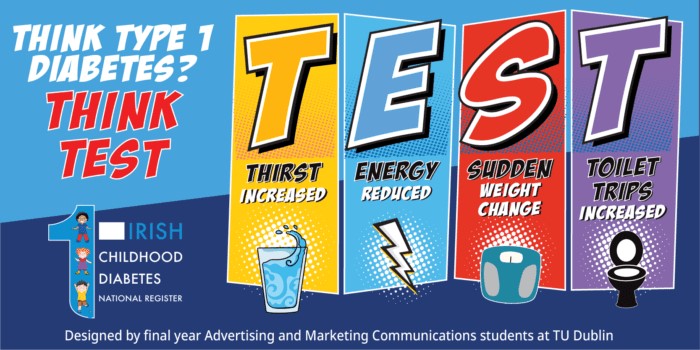
These symptoms may occur suddenly. If they occur, see a doctor. Through a simple test, a doctor can find out if they’re the result of type 1 diabetes.
Prevalence of DKA is very high at diagnosis in Ireland (4 in 10 people), and it can be prevented with earlier recognition of symptoms. More details on TEST campaign aiming at increasing awareness of type 1 diabetes symptoms.
Type 1 diabetes is managed with insulin, either with insulin injections several times a day or with an insulin pump.
Insulin can’t be taken as a tablet.
See more here about insulin and diabetes technology.
Blood glucose levels can be measured using a blood glucose monitor or a continuous glucose monitor which measures glucose in the body’s interstitial fluid.
Healthy eating and regular physical activity are important in daily management of type 1 diabetes.
Learning how to carb-count is an essential part of living with type 1 diabetes.
See this link to learn more about carb-counting.
If you are very newly diagnosed with type 1 diabetes, there is often a “honeymoon period” after you begin taking insulin.
This is where your body’s pancreas still produces some insulin, so your insulin needs may vary for a while.
During this period it’s very important to liaise with your diabetes team more regularly.
Check here for more information about managing type 1 diabetes.

Latent Autoimmune Diabetes in Adults is a subtype of type 1 diabetes and is similarly an autoimmune condition where the body’s immune system attacks the insulin producing cells in the pancreas.
LADA, however, progresses much slower than classic type 1 diabetes and people with LADA may not require insulin immediately upon diagnosis, may not be at risk of DKA, or may have low insulin requirements.
Nevertheless, LADA is treated in a similar way to type 1 diabetes with insulin and daily and frequent glucose monitoring.